[ CELLARS ]
In the cellar of champagne critic Alberto Lupetti
Italia
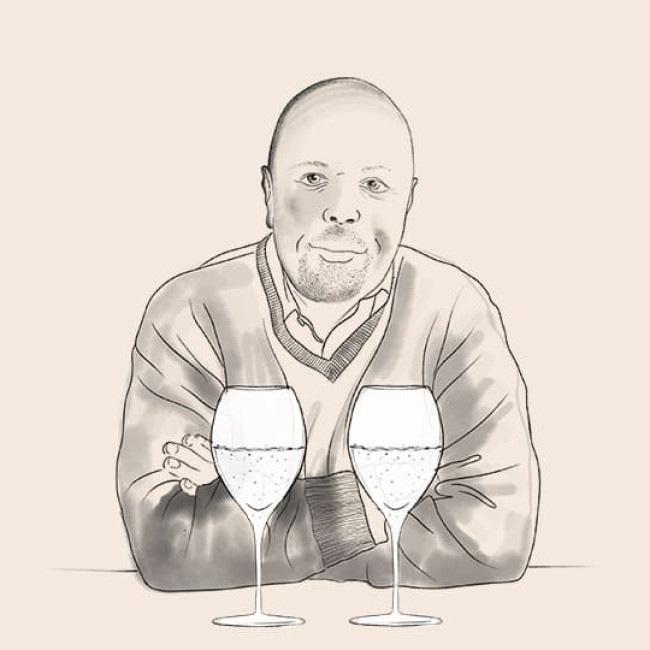
Recognised in Champagne itself as one of the world’s five foremost Champagne critics, Alberto Lupetti has spent more than two decades skilfully sharing his knowledge of the wines through books, masterclasses, articles and tastings.
When asked whether there are still Champagnes he dreams of discovering, he humbly replies: “I have tasted everything back to 1825 Perrier-Jouët, but I’m sure the future holds some great Champagnes”.
Let’s drill down deeper and take a cellar tour through effervescence.
Embracing bubbles
“I first encountered wine at the end of the 1990s. At the time, I was learning more about Italian red wines. Friends and I would meet over bottles of Champagne. That’s when I had my eureka moment: everyone loves Champagne, but nobody really knows what’s in the bottle. So I decided to plug that gap and over the past 25 years have made more than 300 trips to Champagne. And every time I visit, I discover something new”.
Food for thought
“For me, travelling to the wine region is first and foremost about the people I meet. One name that immediately comes to mind is Jacques Selosse whom I consider to be the man who changed Champagne. As early as the 1970s, he began focusing on soils and vines, introducing more sustainable practices that preserved life in the soils. He was among the first to recognise that each place, each terroir, possesses its own identity – and deserves respect. Inevitably, as with any pioneer, he was at first dismissed as mad, especially in an era when chemicals were the norm and vines were seen purely as an industry”.
Champagnes with character(s)
“Since I first took an interest in Champagne, I have witnessed many changes in the way people approach and enjoy it. In the past, people would focus on brands – they didn’t drink Champagne as such but rather ‘Dom Pérignon’ or ‘Roederer’ for example. Today, they venture further afield, discovering other houses, regional characters and even specific vineyard blocks. And that, to me, is where Champagne’s true strength lies, in this mosaic, this remarkable diversity”.
Heart and soul
“Champagne houses, which account for over 70% of the market, strive for a standardised, signature style whereas winegrowers produce wines with greater individuality, which vary from one year to the next, seeking to capture vintage character. I am thinking of wines like the Blancs de Noir and Brut Nature by Benoît Lahaye in Bouzy, the single-vineyard blends and single varietal wines by Fabrice Pouillon and the Substance label by Anselme Selosse or the rosé Champagnes by Eric Rodez. I’m also intrigued by Coteaux Champenois – the still wines crafted in Champagne. It’s a very small niche market, but interest is growing. Wines by Bollinger, Egly and Geoffroy really deserve attention.
Good storage conditions
“There are Champagne wines, and then there is everything that surrounds them, particularly storage and ageing. Some people are willing to invest 1,000 euros in a single bottle, but careful attention to storage is essential – leaving it in the refrigerator for three months is sheer madness! Today people are much more aware of Champagne’s ageability – in fact, the market for mature wine is booming. The same is true for the choice of glasses. In Champagne, it was once common to serve top cuvées in small 8 cl glasses, and and it took twenty years to realise that glasses are also a tool. The ideal shape is the classic wine glass format – not too large – but the most important rule is, never use flute glasses!
In close keeping
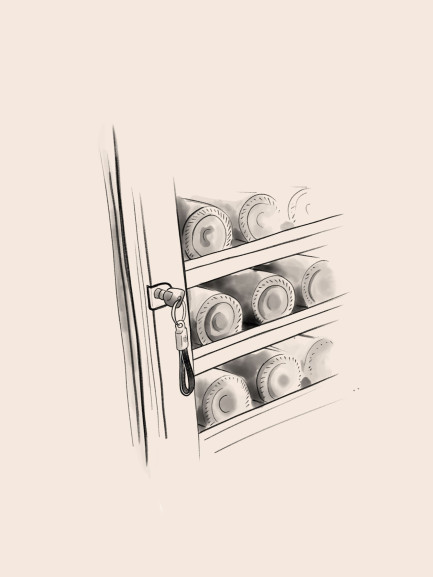
“I’m fortunate to have a natural cellar in a house to store the wines I want to ‘forget about’. But in Rome, and more broadly speaking in cities, EuroCave is the ideal solution. It is the benchmark wine cabinet, offering more than simple refrigeration. I use it for everyday wines, bottles I intend to open in two or three months’ time. Even when temperatures reach 35 to 38°C outside, I know the wines will be in prime condition for drinking. I have also set aside three vintage Blancs de Blancs Champagnes which I will begin opening next year – and I’m looking forward to seeing how they have developed”.
Prolong the experience
Discover the profiles of creative and influential personalities explaining their relationship with wine, the secrets of sommeliers or legendary establishments.
When you subscribe to the magazine, your email address is only used to send you our content newsletter. You can unsubscribe at any time by clicking the unsubscribe link included in each newsletter. To find out more about management of your data and your rights, click here .